This entry is part of an ongoing series documenting how TSIS-related safeguarding concerns moved through IMB channels over time. The series is based on contemporaneous emails, meeting summaries, internal communications, transcripts, and timeline documentation created during the escalation process itself. Identifying information has been redacted.
When safeguarding concerns connected to TSIS first began escalating into IMB channels, we initially approached the process believing institutional structures would help clarify, assess, and appropriately respond to what was unfolding.
Early conversations did not initially feel adversarial.
At first, they felt procedural.
At the time, we still believed the primary institutional question was the safeguarding concern itself.
Over time, however, additional institutional dynamics gradually emerged alongside it:
- communication management,
- relational framing,
- internal stabilization,
- and growing concern surrounding the escalation process itself.
This entry documents the earliest phase of that progression.
Initial Escalation
The earliest IMB-related escalation surrounding the TSIS situation emerged gradually through conversations, disclosures, and supervisory interactions occurring alongside the broader unfolding safeguarding concerns at the school itself.
At this stage, communication largely appeared exploratory rather than defensive.
Questions focused on:
- what had happened,
- whether additional students were involved,
- how the child safety process was unfolding,
- and whether broader organizational structures would intervene appropriately.
Internal communication during this period frequently reflected concern, support, and active information gathering rather than institutional opposition.
Exhibit A
Initial Timeline of Escalation
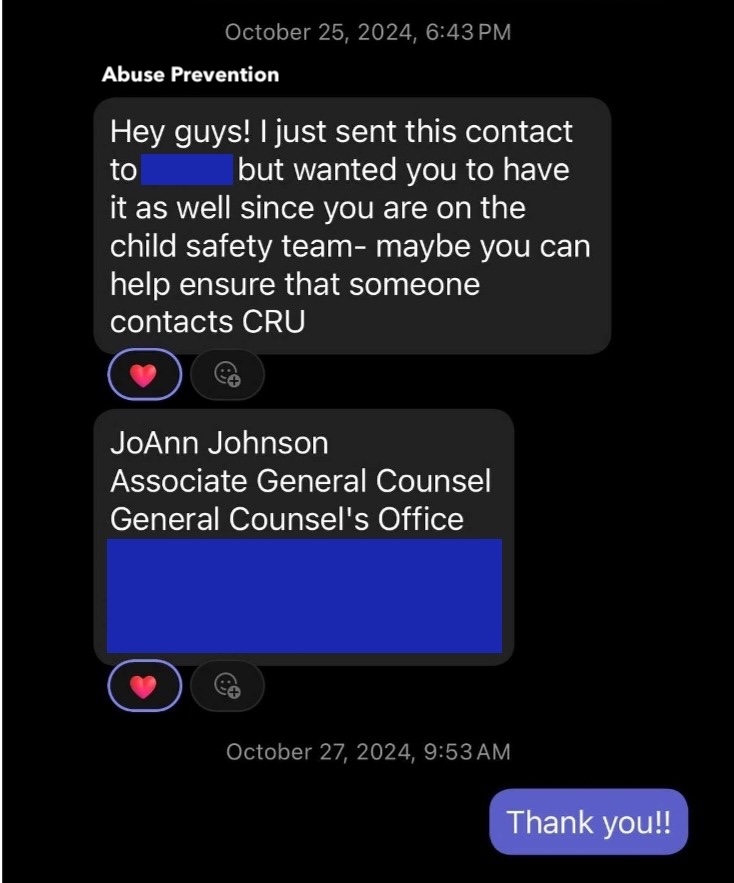
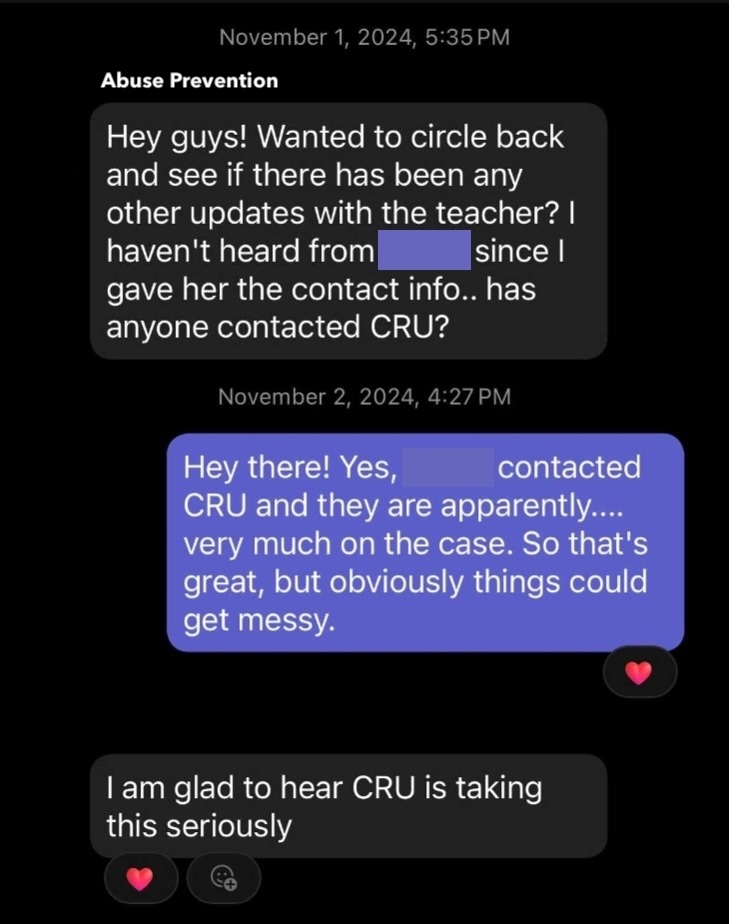
By late October 2024, IMB personnel connected to organizational support structures were already aware that concerns involving Tien Shan and CRU were actively developing.
The IMB’s prevention and response administrator (PARA) provided contact information for CRU legal counsel and expressed concern regarding whether CRU had been contacted about the situation.
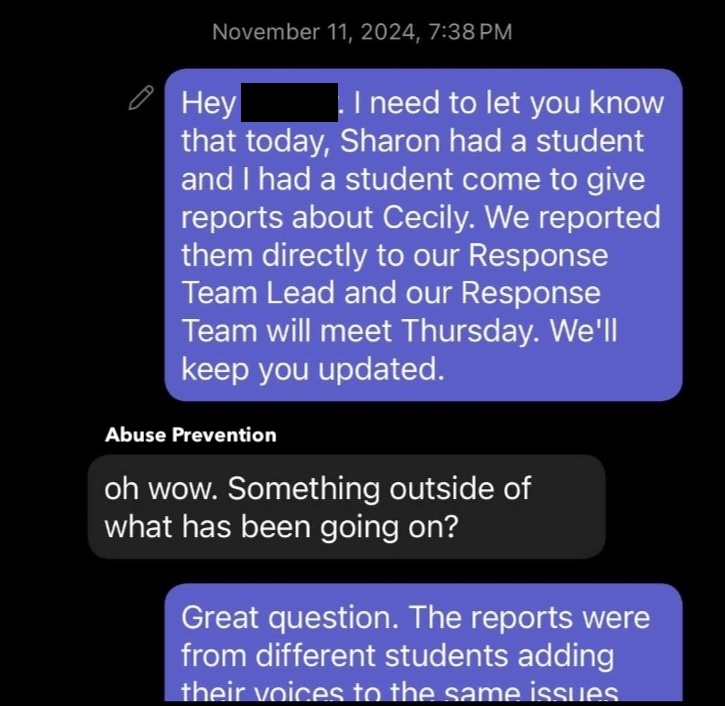
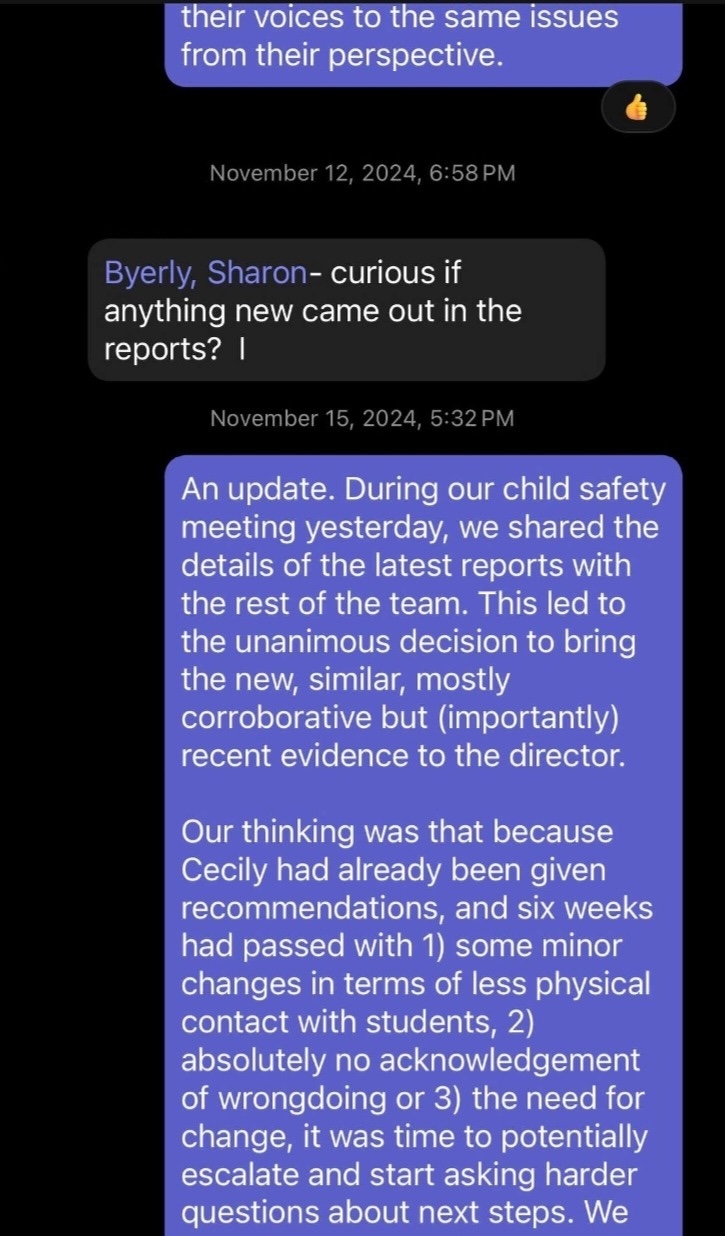
As additional student reports surfaced in November 2024, communication increasingly shifted from isolated incidents toward corroborative patterns involving multiple students.
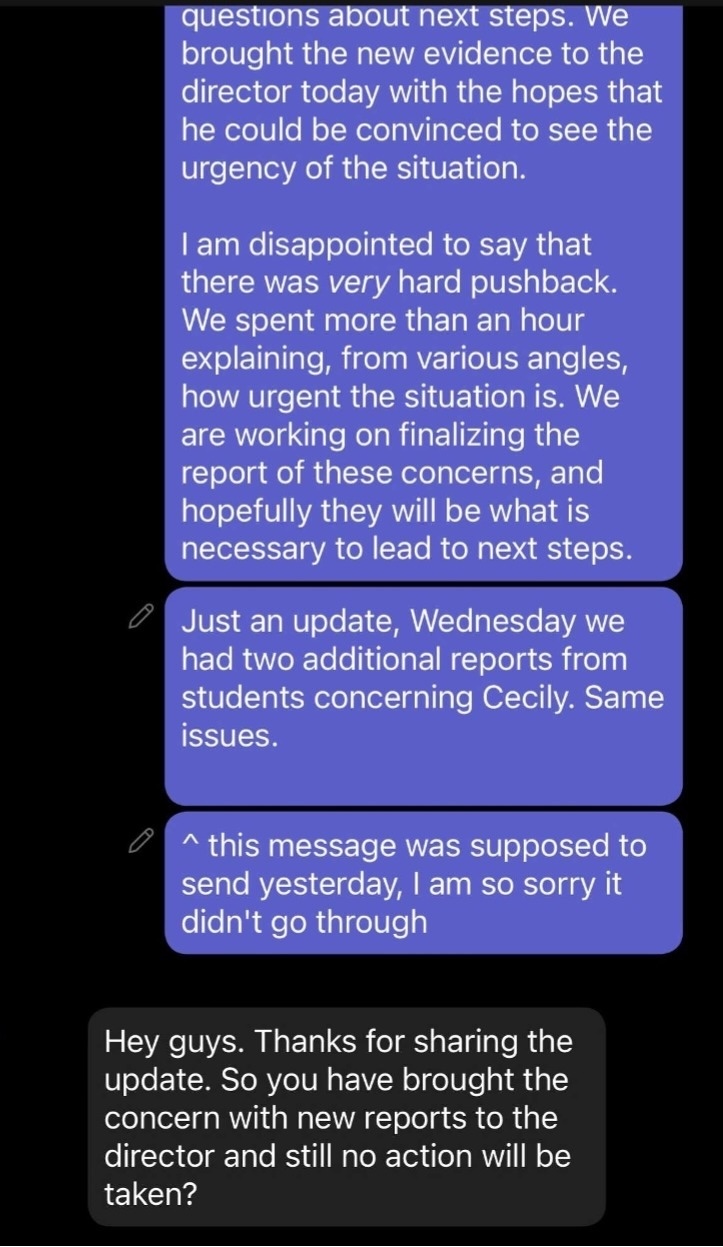
At one point, after we informed PARA that multiple students had independently raised similar concerns regarding Cecily, she responded:
“So you have brought the concern with new reports to the director and still no action will be taken?”
During this period, we repeatedly communicated that:
- multiple students were independently describing similar concerns,
- the Child Safety Team remained concerned,
- recommendations had already been given previously,
- and meaningful institutional action still appeared limited.
The escalation gradually moved beyond internal school structures.
Communication began involving:
- CRU,
- IMB PARA,
- legal consultation,
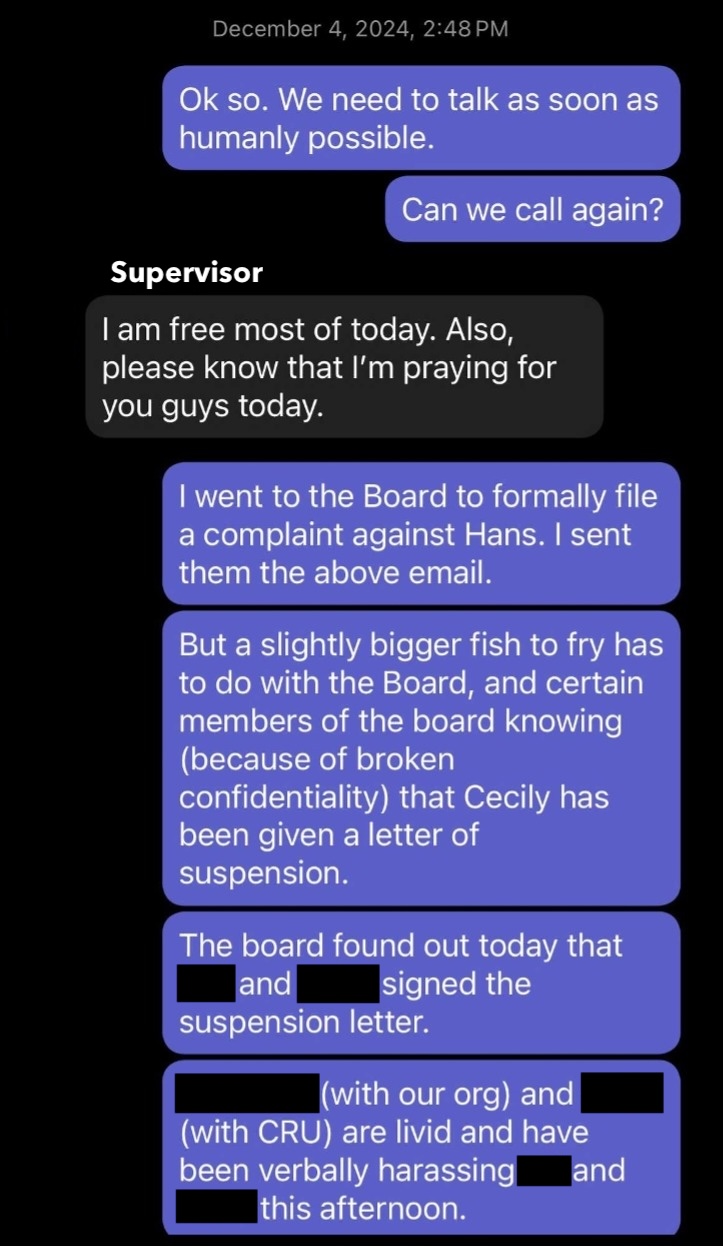
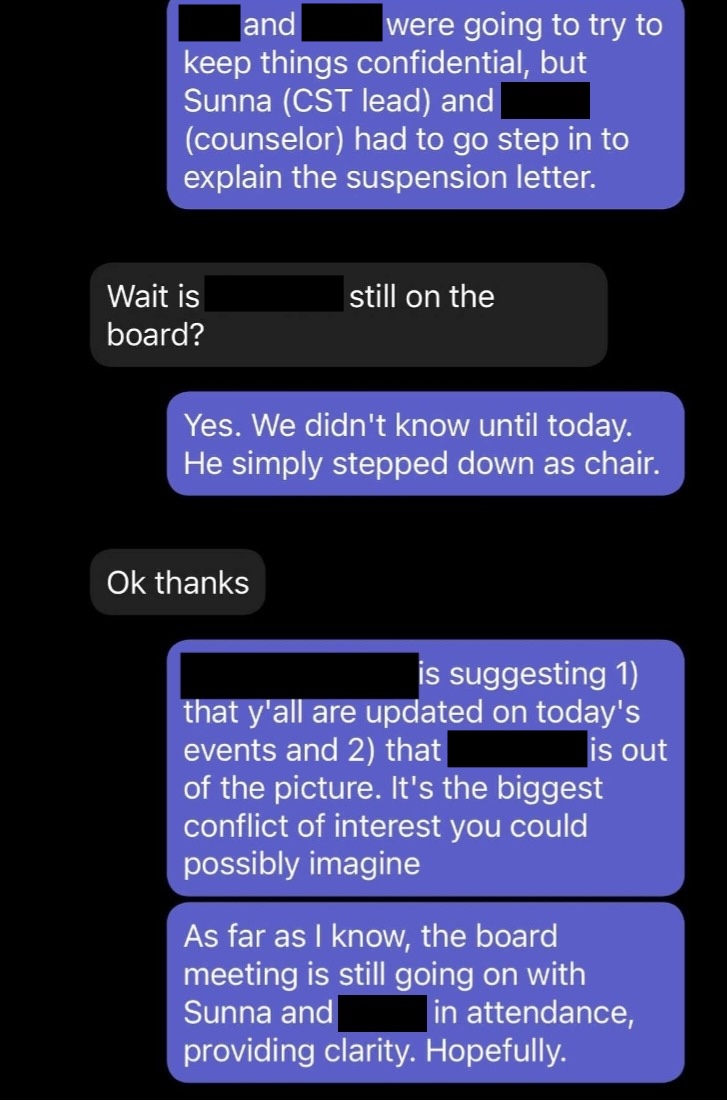
- questions surrounding the TSIS board,
- concerns regarding conflict of interest,
- and broader organizational implications for missionary families connected to the school.
At many points throughout this early phase, IMB personnel appeared supportive, engaged, and concerned about the situation unfolding at the school.
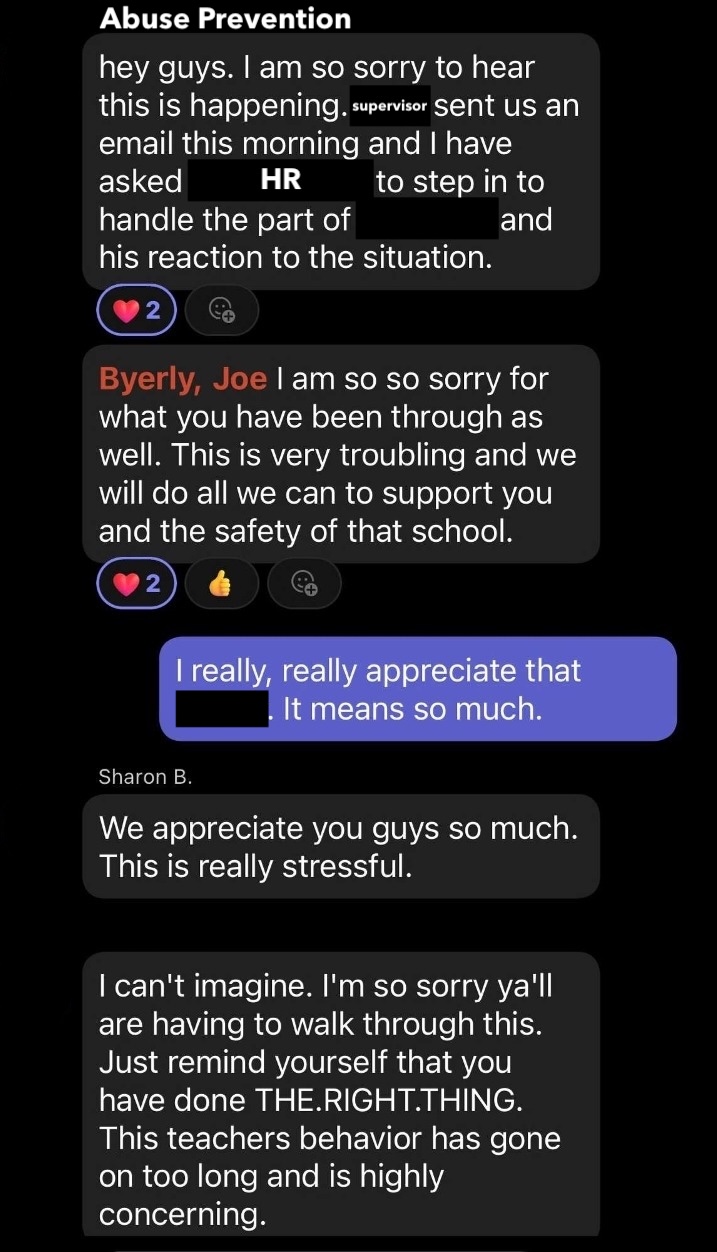
One exchange from December 4, 2024 reflected this posture clearly. After learning additional details surrounding the suspension letter and board dynamics, PARA responded:
“You have done THE RIGHT THING. This teacher’s behavior has gone on too long and is highly concerning.”
At this stage, the institutional process still largely appeared oriented around understanding the situation, gathering information, and determining how broader organizational systems should respond.
Emerging Institutional Strain
As the escalation continued into early 2025, portions of the institutional atmosphere began to shift.
Conversations that had initially focused primarily on safeguarding and information gathering gradually took on additional tension surrounding escalation, disclosure, institutional implications, and internal communication.
One particularly significant moment occurred in late January 2025 during the school’s internal board investigation into the escalating safeguarding concerns surrounding Cecily.
During that period, a student disclosed that TSIS board members had allegedly discovered and revealed the identities of students who had reported Cecily to the Child Safety Team.
According to the student, board-level communication involving student identities had appeared on a television screen connected to a board member’s computer inside the home. The student later stated that students who had independently reported Cecily suddenly appeared aware of one another’s identities and reporting involvement.
The disclosure immediately raised serious concerns regarding confidentiality and the handling of student reports during the escalation process.
The concern was reported to both our supervisor and PARA.
At that stage, we believed the reported breach of confidentiality involving students would likely trigger broader organizational intervention.
Instead, subsequent conversations gradually introduced additional institutional tension involving board relationships, escalation management, reporting posture, and organizational stability.
Exhibit B
Late January 2025 — Student Confidentiality Concerns and Escalating Institutional Tension
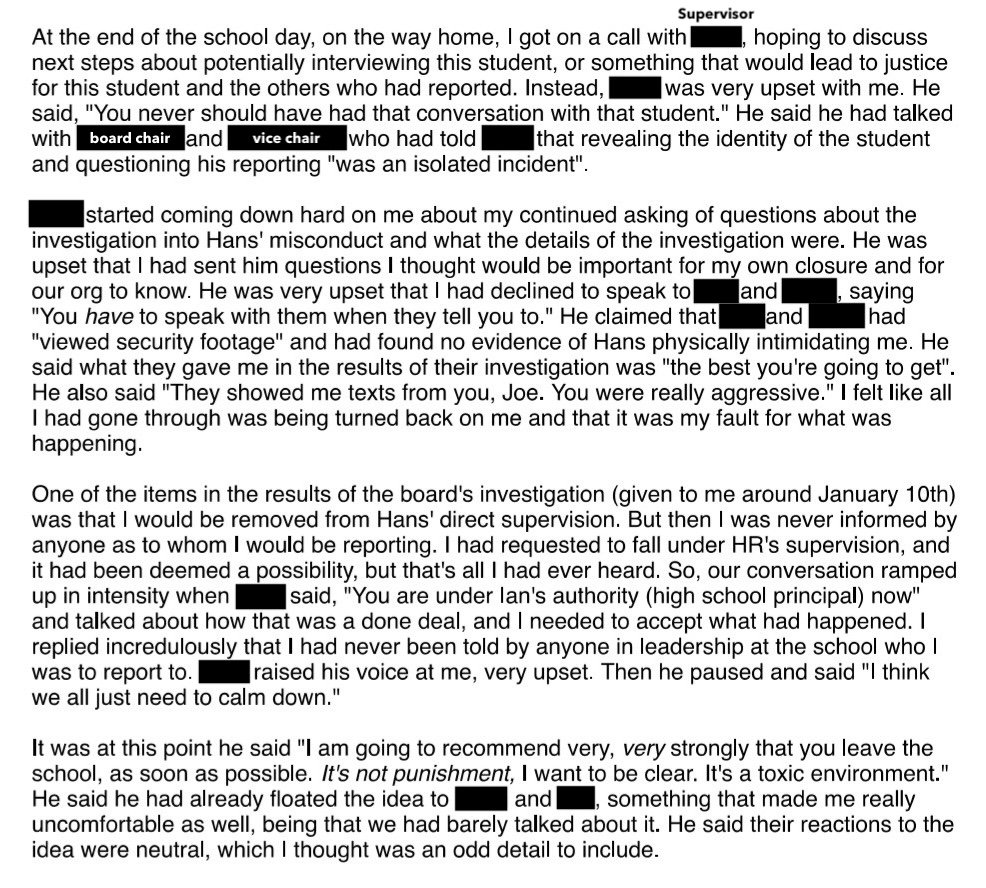
The following summary and excerpt are drawn from a contemporaneous email later sent to IMB HR leadership documenting supervisory interactions and institutional tensions connected to the escalation process.
Following the student disclosure regarding confidentiality breaches, a later call with our supervisor became significantly more tense.
Rather than focusing primarily on the reported breach involving students, portions of the discussion centered increasingly on:
- escalation concerns,
- communication posture,
- relationships with TSIS leadership,
- board dynamics,
- and questions surrounding my own interactions during the escalation process.
During the call, our supervisor stated that TSIS board leadership had characterized the student confidentiality breach as “an isolated incident.”
The conversation also involved discussion surrounding:
- my continued questions regarding the investigation into Hans Fung,
- my refusal to meet with certain board members,
- and institutional expectations surrounding communication and authority structures.
At one point during the discussion, he raised his voice while discussing reporting structures and next steps concerning my continued role at the school.
Shortly afterward, he strongly recommended that I leave Tien Shan “as soon as possible,” while simultaneously emphasizing that the recommendation was “not punishment” and describing the environment as “toxic.”
The conversation became increasingly disorienting because multiple institutional realities seemed to coexist at once.
On one hand:
- IMB personnel continued expressing concern regarding the school environment,
- acknowledged serious dysfunction within TSIS leadership structures,
- and privately described the school environment in deeply negative terms.
Alongside this, conversations increasingly reflected concern surrounding:
- escalation,
- institutional relationships,
- communication posture,
- and stabilization alongside the safeguarding concerns themselves.
The dynamics felt more layered than a straightforward attempt to suppress reporting.
At many points throughout the process, we genuinely felt cared for and supported by our supervisor personally. He traveled to Kazakhstan to advocate for us and remained involved throughout much of the escalation.
At the same time, broader institutional pressures gradually became more difficult to ignore.
The school represented a major organizational hub for IMB families.
Questions involving:
- partnership preservation,
- board relationships,
- organizational stability,
- institutional liability,
- and escalation management
increasingly shaped the atmosphere surrounding the situation.
Over time, the escalation itself gradually appeared to become part of the institutional problem being managed.
Early Supervisory Meetings
One of the earliest significant supervisory meetings occurred on February 18, 2025 during a conversation with IMB field leadership.
Importantly, the person who met with me was not part of my own direct supervisory chain at the time.
That distinction mattered because the conversation increasingly appeared to reflect not only direct personnel concerns, but broader institutional concern surrounding the escalating situation itself.
Portions of the meeting suggested that the institutional discussion was beginning to involve not only the safeguarding concerns themselves, but also broader questions involving tone, relational dynamics, institutional trust, and how individuals were emotionally processing the situation itself.
Exhibit C
February 18, 2025 Meeting Summary — Field Leadership
The following summary was documented contemporaneously following the meeting.
During the conversation, he referenced having recently spoken with our supervisor, who had traveled to Almaty to assess the school situation.
Early in the meeting, the discussion moved beyond the safeguarding concerns themselves and into broader observations regarding my personality and communication style. He described me as “hyperbolic” and stated that I had significantly influenced his son toward similar tendencies. The characterization was notable because similar language had previously appeared in an official quarterly review he had written about me prior to the meeting itself.
The conversation also repeatedly returned to themes involving relationships, healing, emotional framing, and perspective.
At one point, after discussing the danger posed by Cecily’s continued presence within the school environment, he responded by stating:
“the world is a dangerous place.”
The comment itself may have been intended philosophically or pastorally.
But within the context of an active safeguarding escalation involving multiple student reports, ongoing institutional conflict, and unresolved concerns surrounding student safety, the statement felt deeply disorienting.
By this stage, relational framing increasingly appeared alongside safeguarding discussions.
Questions involving:
- communication style,
- escalation posture,
- institutional trust,
- emotional processing,
- and interpersonal dynamics
were increasingly being discussed alongside the original concern itself.
Emerging Institutional Priorities
As communication continued into early 2025, additional institutional themes increasingly surfaced within emails, Teams conversations, supervisory guidance, and reporting interactions.
These themes did not negate the underlying safeguarding concerns.
In many cases, IMB personnel openly acknowledged serious dysfunction within the school’s leadership and child safety response.
At the same time, however, communication increasingly reflected another institutional reality developing alongside the safeguarding concerns themselves:
the growing challenge of managing the escalation.
Exhibit D
March 17, 2025 - Conversation with Supervisor
One of the clearest examples of this dynamic emerged during a March 17, 2025 conversation regarding ongoing communication surrounding the TSIS situation.
Earlier Transparency and Parent Communication
This conversation did not emerge in a vacuum.
Earlier in the escalation process, our supervisor had traveled to Kazakhstan, acknowledged the seriousness of the underlying concerns, and supported transparency regarding what had occurred at the school.
At that stage, we understood that parents deserved accurate information regarding the safeguarding concerns, the school’s response, and the broader institutional situation unfolding around them.
As a result, by the time of the March 17 conversation, discussions with parents and members of the school community regarding what had happened were already ongoing.
That context matters because institutional concern surrounding continued communication did not emerge at the beginning of the escalation process.
It developed gradually as the situation expanded beyond the school’s internal structures and generated broader institutional strain.
Institutional Disagreement With TSIS
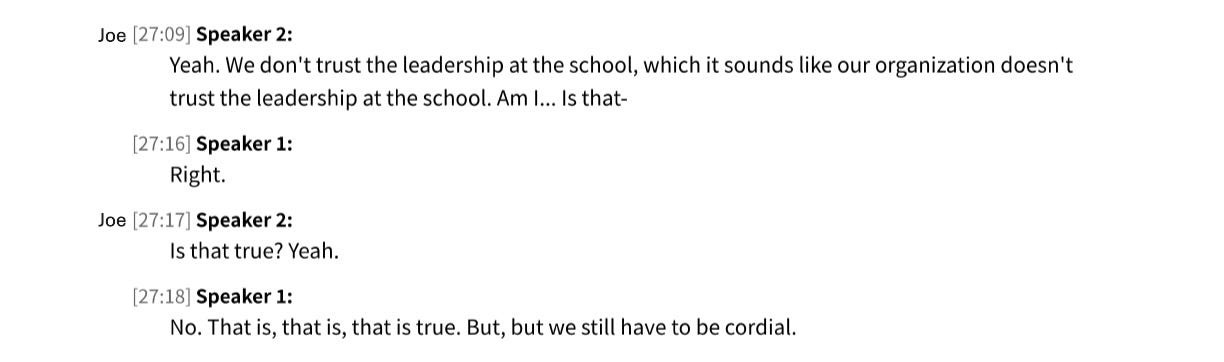
Throughout the discussion, our supervisor repeatedly acknowledged that IMB disagreed with the school’s handling of the situation and believed serious failures had occurred.
At one point, he stated directly:
“After the investigation that was done, we feel like she was guilty and should step away from the school.”
He also described TSIS as:
“the most dysfunctional school I’ve ever seen.”
“Burning Bridges” and Escalation Concerns
At the same time, however, the conversation repeatedly returned to themes involving:
- institutional relationships,
- communication management,
- organizational perception,
- partnership preservation,
- and escalation control.
Our supervisor explained that the school increasingly viewed the Byerlys themselves as a source of institutional conflict and repeatedly warned that additional conversations with parents or students could be perceived as “an attack on the school.”
At several points, he emphasized the need to remain “cordial” with school leadership despite IMB’s disagreements with the school’s handling of the situation.
He also repeatedly stressed concern about:
- “burning bridges” with TSIS,
- preserving future partnership possibilities,
- and maintaining stability for the remaining IMB families whose children still attended the school.



Remaining in Country Through TSIS Graduation
At the time of this conversation, our family had initially planned to remain in Kazakhstan through the TSIS graduation ceremony and the end of the semester in order to help our TCKs transition well, pursue closure with the community we had lived alongside for years, and leave the field carefully rather than abruptly.
Throughout the March 17 conversation, our supervisor repeatedly acknowledged the value of that desire for closure and transition.
At the same time, increasing concern emerged surrounding our continued presence in Almaty while also continuing to discuss the situation openly with parents and students.
He repeatedly emphasized that school leadership increasingly viewed our conversations with others as “an attack on the school,” expressed concern about “burning bridges” with TSIS, and warned that tensions surrounding our continued presence could continue escalating.
While discussing our desire to remain in-country through the semester, he stated:
“I do question that time a little bit.”

He later encouraged us to:
“minimize contact” with students and school leadership while remaining in-country.

The conversation never became an explicit ultimatum.
But over time, the practical implication became increasingly difficult to ignore:
the longer we remained in-country while continuing to openly discuss the situation with members of the community, the more institutional tension appeared to increase around our continued presence there.
That tension became especially difficult because our desire to remain was not primarily about conflict with the school itself.
It was about helping TCKs transition safely and gradually out of the only community they had known for years.
Escalation and Institutional Pressure
During the conversation, our supervisor acknowledged that IMB had already:
- frozen teacher placements,
- warned IMB families about child safety concerns,
- and internally disagreed with the school’s decision to retain Cecily.
At the same time, he repeatedly encouraged minimizing further escalation with students and parents because of the school’s growing perception that the situation itself was becoming adversarial.
Again, as with my late January conversation with him, the interaction did not initially feel like a direct attempt to suppress reporting.
He repeatedly expressed personal care, empathy, and agreement with many of the underlying concerns. He openly acknowledged dysfunction within the school and appeared genuinely concerned about student safety and the well-being of missionary families.
That complexity matters.
The tension appeared to emerge not from a complete rejection of the safeguarding concerns themselves, but from competing institutional pressures developing alongside them.
Competing Institutional Priorities
By this stage, several institutional priorities increasingly appeared to coexist simultaneously:
- concern regarding student safety,
- protection of remaining IMB families,
- preservation of organizational relationships,
- management of escalating conflict,
- future partnership considerations,
- and concern surrounding how the situation was being publicly perceived within the school community.
Viewed independently, many of these communications may reflect ordinary organizational caution during a highly sensitive institutional crisis.
Viewed collectively, however, they increasingly suggested that safeguarding concerns were no longer moving through the system alone.
Concerns surrounding:
- relationships,
- escalation management,
- institutional trust,
- communication control,
- partnership preservation,
- and internal stability
were increasingly appearing alongside them.
The original concern remained present.
But it was no longer the only institutional concern in the room.
Over time, the institutional posture did not simply become more oppositional.
It became more layered.
That complexity would become increasingly important as the escalation continued.
In Part 2, we examine how the institutional posture increasingly shifted as the escalation continued.
This post is also published on Substack: