This entry is the final installment in our series documenting how TSIS-related safeguarding concerns moved through IMB channels over time. The posts are based on contemporaneous emails, transcripts, internal communication, meeting summaries, and timeline documentation created during the escalation process itself. Identifying information has been redacted.
Earlier entries focused on:
- the original safeguarding concerns,
- internal reporting efforts,
- institutional communication,
- and the widening institutional strain that gradually emerged.
What follows focuses on where that escalation ultimately led:
the public grief over what had happened, the growing institutional tension surrounding continued communication, and our family’s eventual removal from the field.
Escalation Beyond the School
By April 2025, the situation concerning TSIS had expanded far beyond the original safeguarding concerns themselves.
Internal conversations reflected tension regarding communication, institutional relationships, legal sensitivity, and growing concern about how the broader escalation was being perceived externally.
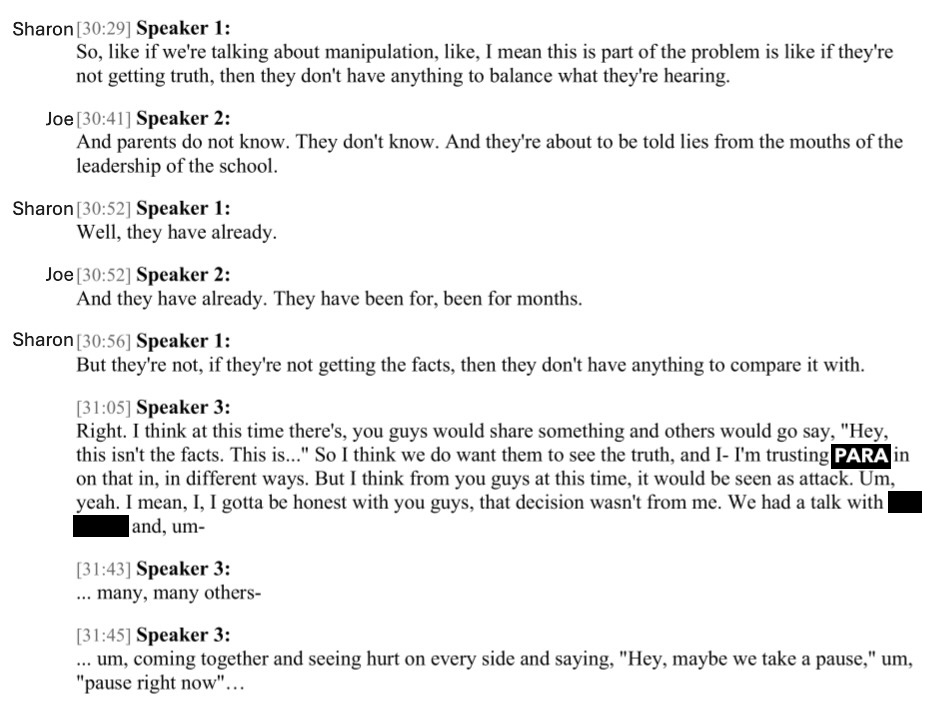
In one April 5 conversation, our supervisor explained that requests for us to “pause” broader communication had already been discussed with senior field leadership “and many, many others.”
The concern, he explained, was that outside communication was being interpreted as representing official IMB positions rather than solely the perspective of our family.
At the same time, however, internal concern with the school itself had not disappeared.
Earlier conversations had already included extraordinarily serious private assessments of TSIS.
But the escalation itself was creating institutional strain far beyond the school alone.
Communication concerns widened.
Leadership involvement expanded.
And the escalation became an organizational management issue alongside the underlying safeguarding concerns themselves.
Public Grief
Internal reporting structures had intensified.
Requests to “pause” broader communication had emerged.
Relationships throughout the community had become increasingly fractured.
It was during this period that we wrote a song (released on April 11, 2025) attempting to emotionally process what we had experienced.
[Listen to “Wolves on the Mountains of Heaven” here.]
Although the song emerged from the TSIS situation, it was written primarily as an expression of grief.
Grief stemming from:
- fractured relationships,
- missionary pressure,
- organizational conflict,
- and the growing fear that the system itself seemed unable to hold child safety concerns, institutional relationships, and missionary continuity together simultaneously.
At the emotional center of the song was a question that increasingly seemed impossible to ignore:
“Why does this place exist?
To nourish our children,
Or ensure the Work persists?”
Later in the song, the imagery became even more direct:
“You offered Isaac on the wood you brought along.”
The song quickly became a significant escalation point within the organizational atmosphere.
At that stage, the conflict was no longer confined primarily to:
- internal reporting structures,
- supervisory conversations,
- or organizational process.
It had become:
- public,
- emotional,
- relational,
- and community-wide.
Internal Review Processes
Simultaneously, internal review and investigative processes were still actively ongoing.
We ourselves participated in portions of the review, including investigative interviews.
Throughout this period, organizational leadership repeatedly emphasized confidentiality surrounding the investigation itself.
In one April 22 communication, participants were reminded that:
“this investigation remains confidential.”
The same communication requested that participants:
“refrain from discussing the investigation with others or posting any related content online…”
and additionally asked that individuals:
“hold further information or materials related to the case until we have concluded this phase.”
At the time, we did not necessarily interpret the requests primarily as attempts to suppress reporting.
Initially, portions of the communication appeared aimed at preserving investigative integrity and preventing further destabilization while organizational review processes remained ongoing.
However, the broader process often remained difficult to fully understand from our vantage point.
While we did eventually learn that certain actions had been taken — including requests that a specific IMB leader step away from leadership responsibilities, including involvement with the TSIS board — investigative outcomes and internal determinations were never fully shared with us directly by IMB leadership.
That tension became part of the strain within the situation itself.
April 23, 2025 - Call with HR
By late April, the escalation moved into organizational management structures.
During an April 23 call involving IMB HR leadership, the discussion moved directly into growing institutional concern about the song itself.
HR stated directly that the song was:
“creating some issues for us.”
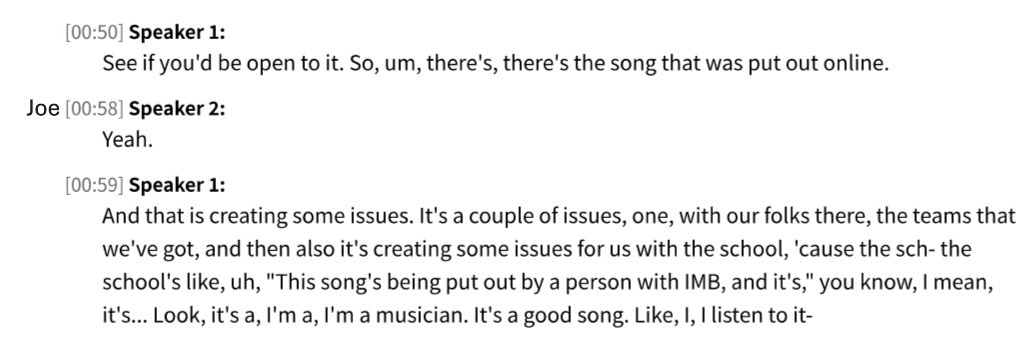
He explained that the school viewed the song as being associated with IMB personnel and stated that it was:
“kinda undermining some other things that we’re wanting to do.”
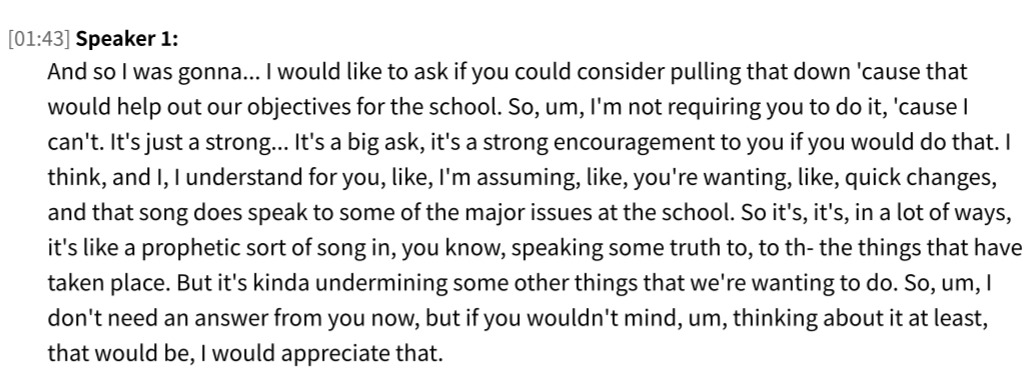
He then asked whether we would consider taking the song down:
“I would like to ask if you could consider pulling that down…”
Importantly, however, he also stated:
“I’m not requiring you to do it, because I can’t.”
The conversation remained notably calm and relational throughout.
The exchange did not come across as a straightforward effort to suppress dissent.
Instead, it revealed how difficult it had become for the organization to simultaneously sustain:
- ongoing public escalation,
- strained institutional relationships,
- school partnership concerns,
- missionary infrastructure,
- and continued field presence.
Later in the same call, the conversation shifted into formal organizational decisions regarding our continued presence in Kazakhstan.
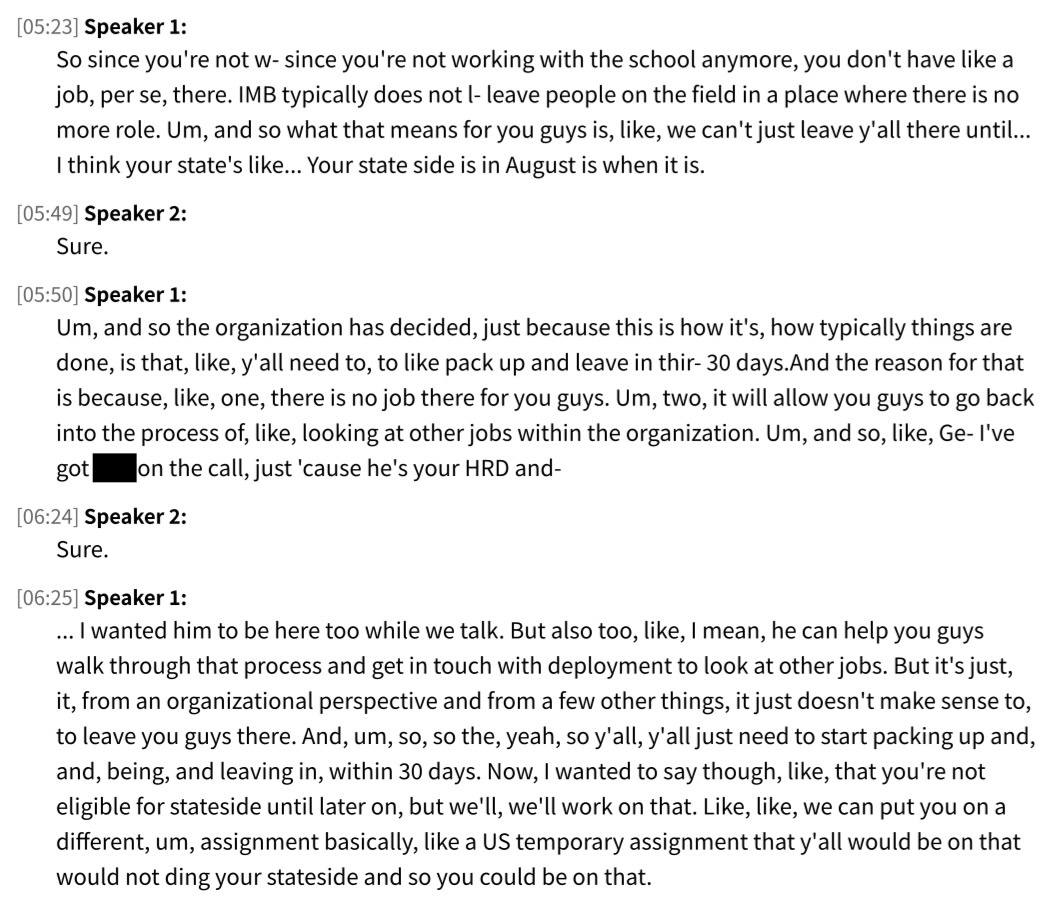
HR explained that because we were no longer working within the school itself:
“it just doesn’t make sense to leave you guys there.”
Notably, by the time of the April 23 conversation, we had already been out of the school itself for nearly three months following our January departure from TSIS.
He then stated:
“the organization has decided… y’all need to… leave within 30 days.”
The tone of the conversation remained sympathetic throughout.
He repeatedly emphasized:
- support,
- care for our family,
- and willingness to assist us through the transition.
But the practical implications were enormous.
Only weeks earlier, our family had still hoped to remain through TSIS graduation and the end of the semester in order to help our students transition carefully out of the only community they had known for years.
Instead, the timeline suddenly contracted dramatically. Our departure would occur just 11 days before TSIS graduation.
In the final part of the call, we learned that our reporting structure inside the organization was changing.
We were informed that we would no longer report through previous supervisory channels and would instead report directly through HR structures.
The shift was not accompanied by extensive explanation, but it reinforced the sense that the situation had moved beyond ordinary field leadership processes and into organizational management structures.
As with the song, this portion of the conversation never framed the decision as punishment for reporting concerns or speaking publicly.
By late April, the tensions present in earlier conversations had become organizational realities.
Continued public escalation, ongoing field presence, relational tensions, and institutional stability no longer seemed sustainable together.
Closing Reflections
This series is not intended to argue that nobody within the system cared.
In many cases, individuals inside the system:
- expressed genuine concern,
- advocated internally,
- acknowledged dysfunction,
- warned families privately,
- and were sincerely troubled by what was unfolding.
That is important to say clearly.
But the system appeared unable to reconcile:
- safeguarding escalation,
- institutional relationships,
- public communication,
- missionary continuity,
- and ongoing field presence
all at the same time.
Over time, remaining in-country while continuing to openly discuss what had happened became less and less sustainable.
The result was not merely organizational restructuring.
It carried profound human consequences for our family, especially for our daughter, who was suddenly forced to leave behind the life, friendships, and stability she had known for years under dramatically accelerated circumstances.
Relationships fractured.
Closure became difficult.
And the escalation regarding the safeguarding concerns consumed nearly every remaining institutional structure surrounding our lives in-country.
This concludes this portion of the documented timeline concerning IMB involvement in the TSIS escalation process.
Much of what happened afterward — including broader institutional fallout, external reporting, and additional developments beyond our direct experience — extends beyond the scope of this series itself.
This post is also published on Substack:
tsisaccountability.substack.com/p/when-the-escalation-became-the-problem